Monday, 2 October 2017

3D Hot Air Balloons

Last year, I did this art lesson with my class but this year when I decided to do it again I had forgotten how exactly I did it. So I am going to jot it down here for future reference!


Materials

  • Various Coloured paper-A4
  • Hot Air balloon template or blank page
  • Scissors
  • Pritt Stick
  • Rulers
  • Pencils

How to make them them

First off, I gave each child one coloured page. (Giving each child in a group a different colour will help to divide them out easily after)
Placing it portrait in front of them, they marked 1.5cm intervals across the page using their ruler and pencils.


Then they cut their coloured page along the intervals, leaving them with strips 1.5cm in width.
The children can  then share out the coloured paper so they have a mixture of coloured strips.

I gave my class a hot air balloon template but the children can also draw their own.
Fold about 2cm of the strip on each side. Put Pritt stick on the folded part. Place the part with Pritt stick on the edge of the hot air balloon and on the opposite side of the balloon.

Continue with the next strip until you have made you way around the balloon, placing one side north of the previous strip and one side South.
Decorate the hot air balloon with people, surrounding clouds etc.


Tips
Try to put strips right  beside each other to avoid gaps.
Ensure children fold the edges of the strips inwards rather than outwards.


Integration Ideas

English: Procedural Writing, Creative Writing
History: the first Hot Air Balloon
Science: how a hot air balloon flies
Geography: Transport


Sunday, 24 September 2017

Books Worth a Look #2 'Pax'


This is the second in a series of blog posts on some good books that I have come across while teaching a variety of classes. (I have purchased these books myself and do not receive sponsorship/freebies for reviewing them!)

The second book is 'Pax', a new-ish book to me. It is one that I really enjoyed reading myself. It is written by Sara Pennypacker and has lovely illustrations by Jon Klassen.


Theme/Overview


The main theme of this book is friendship. It is about two friends who are separated, it just so happens that one of them is a boy (Peter) and one is a fox (Pax).In order to be reunited, both of them face many obstacles including war (yet war is not the main focus of the book).  The book explores how true friendships can overcome even the most difficult and dangerous situations.

I particularly liked how it is written from perspective of both Peter and Pax, in alternate chapters. Personally, I would do this with a senior class as it does refer to war from time to time. It is important to note it does deal with the loss of a parent so may not be suitable to do if a child has experienced such a loss.


Activities/Ideas


  • Research foxes- create a report piece of writing (click on image to get blank templates)

  • Use the book as a stimulus to explore the theme of war (book does not specify which war)
  • Fill a backpack (Peter brought some useful items and treasured possessions with him), ask the children what they would bring. They could draw a backpack with their chosen items inside.
Image Source

  • Visualisations: This story lends itself nicely to working on the comprehension strategy of visualisation. 
  • Traits of a good friend: Discuss the important traits of a good friend.
  • Friendship recipe: similar to the idea above, choose the most important traits of friendship.
Image Source 

  • My pet: Discuss or complete a project on their pets and their favourite things about them. If some children don't have pets try the next activity.
  • If I could have any pet it would be.....
  • Read the poem 'The Dentist and the Crocodile' by Roald Dahl
  • Do some art inspired by foxes!
This Fox drawing lesson has been pretty popular, and so I thought I’d make an easy downloadable pdf file to help in the classroom. To create the look of my sample, have students draw on black paper, trace the lines with a black oil pastel, and then fill in as shown. • View and download Fox … Read More
Image Source
Newspaper Fox art project from Art Projects for Kids
Image Source


Check out the other Books Worth a Look posts:


Wednesday, 20 September 2017

Jenga Blocks in the Classroom

I purchased this set of Jenga blocks for only €4 in Tesco's last week.

I try to have a few games on each set, to get extra value for money! For example I have multiplication on one side of the blocks and a division set on the other.
Here are a few ways I like to use them in station teaching or as an early finisher activity.

 Maths

  • Multiplication and division tables (useful to leave a multiplication square at the station so they can check answers)
  • Addition and Subtraction tables for younger classes
  • Fractions: 1/4 of 20
  • Percentages: 30% of 10
  • Decimals: 0.1 of 20
  • Number Sequences or patterns: 12, ____, 14 or 3,6,9, ____
  • Rounding numbers to nearest 10, 100, 1000

Gaeilge

Write the root of the verbs on the blocks and the children can change the verb to one of the following:
  • Aimsir Chaite
  • Aimsir Láithreach
  • Aimsir Fháistineach
  • Question form/negative of verb


English

  • Prefix/Suffix
Add a prefix/suffix to each block and the children have to give a word that contains the prefix or suffix

  • Phonics 
Put letters and letter blends (e.g. th) on the blocks and the children have to say a word with that letter sound


  • Conversation Starters (Oral Language)
Image result for conversation jenga
Image Source


Ways to play

Remove one piece at a time and keep it of you get the answer correct. When the tower collapses, whoever has the most blocks is the winner.

OR

Place each piece on top after you answer the question. Use a whiteboard or paper to record correct answers.

Feel free to add other ideas for using Jenga blocks in the comments below.

Tuesday, 12 September 2017

Tantrix Puzzles

On a recent trip to New Zealand, I stopped off at Puzzle World, home to the first 3D 'Supermaze'.
You can also just grab a coffee and try out lots of puzzles for free!

While there, I bought a couple of puzzles including Tantrix, which originated in New Zealand. It is really good for problem solving skills and requires perseverance!

There are many different sets but I bought a basic one for my class. 


In this set, there are varying levels of difficulty starting with a 3 piece puzzle. The number on the back tells you what colour the loop must form. For example, the number 8 is blue so the eight pieces must make a complete blue loop (while the other colours must link correctly too!)


I am looking forward to seeing how the students get on with it on rainy days or as an early finisher activity! 

I have also ordered this more complex one online since coming home.

                                                Image result for amazon tantrix
You can order from www.puzzlingworld.co.nz but the shipping charges are expensive. I purchased the second set from Amazon.

To find out more about Tantrix and try it out outline, have a look at www.tantrix.com

Wednesday, 23 August 2017

Books Worth a Look #1 'The Dot'


This is the first in a series of blog posts on some good books that I have come across while teaching a variety of classes. (I have purchased these books myself and do not receive sponsorship/freebies for reviewing them!)


First up is 'The Dot' by Peter H. Reynolds which I will be doing with my new students on the first day of school as I introduce our classroom rules.


Image Source

Theme/Overview


The book is about a child struggling with an Art activity (but really I think it can be applicable to all subjects). It is about trying, even when it is difficult and you feel you can't do it...YET!  Even though it may be daunting or make us feel uneasy, making a start is important or as we say in Irish 'Tús maith leath na hoibre!' It ties in nicely with the idea of Growth Mindset. 

It encourages us to be creative in our learning and teaching (that there isn't just one way to do something) which is why I have chosen to read it on the first day back to school.


Activities/Ideas


These are just some ideas to pick and choose from that you could use alongside the book.
  • Discuss before reading the story what it feels like when faced with a new beginning or start (first day back to school, new pupil in the class etc.)


  • Read the story again but change it to another subject, for example Maths to show the children that the main idea of the story is applicable to more than just Art


  • The book could also be a stimulus for an Art lesson for the children to make their 'own mark'


  • Chat about how the children could make their mark this year (what they would like to achieve, what they would like to improve on) 


  • Do some Pointillism Art using dots and look at artist Seurat

  • Do some Kandinsky inspired 'Dot' Art
Kandinsky_Farbstudie-Quadrate
Image Source

  • create a class contract for the year to always try our best and 'make our mark'. Each child can sign their name beside their dot (perhaps their fingerprint).

  • Design a Growth Mindset Poster for displaying in the class. Have a look here at some examples or click the image for others.
Image Source

They now even have an International Dot Day which is the 15th September this year! More details can be found here where they have more ideas for the book.

Tuesday, 22 August 2017

5 printable resources for First Day Back (all Freebies!)


Here are five sheets I will have printed for my first day or two back in the classroom.


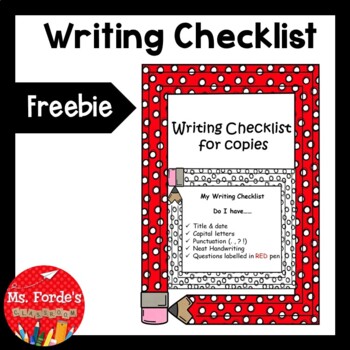
1. Checklist Page for Homework Diary


I print this out each year and get the children to attach it to the inside cover of their homework diary. It does take some training in getting them to use it, but it does give them clear expectations on what you expect from homework.
You an download it here.
Writing Checklist for Copies FREEBIE

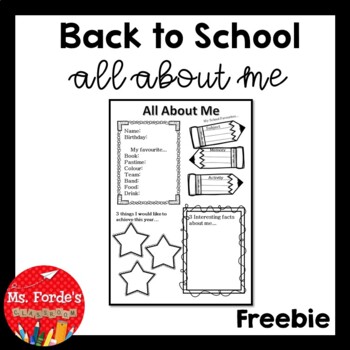
All About Me Sheet


Free Back to School Info Sheet
A nice way to get to know the children on the first day back. Other ideas of Back to School Activities can be found in another post by clicking here. Click on the image to download it for free.

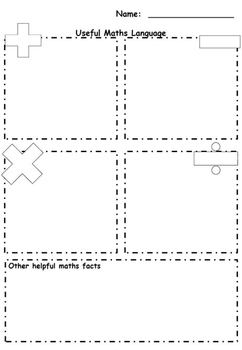
Mental Maths Sheet

I stick this into the back of their mental maths book.  During the first few weeks back to school, we add key maths language for addition, subtraction etc. as we come across them in our book. This can be used as an aid for the children as the year progresses. Children can also add in their own facts and maths language that they find tricky. You an download this freebie  here.

                                                 Maths Language Template

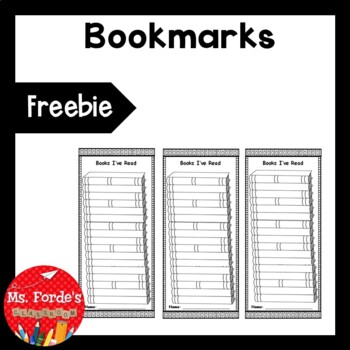
Bookmarks

I print these on card to make them a bit more durable. The children can decorate them and the idea is each time they complete a book they record the name of it on the bookmark, seeing their collection grow (hopefully!) as the year progresses.

                                Bookmark (record books read)

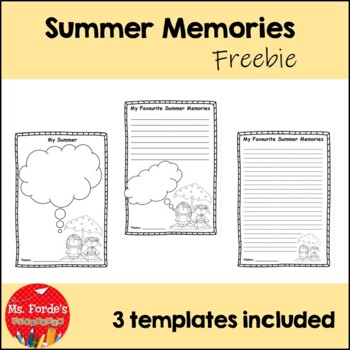
Summer Memories Worksheet

This is another freebie that is differentiated and can be used in all class levels. It is useful as an oral language activity,  to revise recount writing and to see the starting point for each child. I sometimes bind them altogether and make our first class book of the year. Click on the image to download 3 different options.

                                               Summer Memories Freebie (Back to School Activity)

If you find these useful, please rate them on my TPT store! :)

Find other Back to School Posts here:

First Day Back to School Activities


Friday, 18 August 2017

Gaeilge Mé Féin Stations/Activities

In another post I have outlined how I approached and structured Gaeilge Station Teaching last year. 
Here are some ideas for doing stations based on the theme of Mé Féin.

Guess who/ Cé tusa?

I had a Guess Who lying around at home from years ago. It is a great way to get the children to use the language based around hair colour, eye colour etc. A little pre teaching of the questions beforehand is all that is needed or give them a laminated list for questions for the first few games to help them. Here are some ideas of questions:
  • An bean/cailín í?
  • An fear/buachaill é?
  • An bhfuil gruaig ________ air/uirthi?
  • An bhfuil súile _________ aige/aici?
  • An bhfuil sé/sí ard?
  • An bhfuil sé/sí íseal?
  • An bhfuil sé/sí ramhar?
  • An bhfuil sé/sí tanaí?

A lot of families probably have the game so you could ask children to bring it in. Otherwise team up and allow two children to work against two others. For the older students, you can make it trickier by making them miss a turn if they speak any English.

If you don't have the board game, print an A4 page with a photo of each child in the class on it. Use counters to mark off the children as they narrow it down.

Puppets/Puipéid

Last year, I printed out various images from Google, laminated them and stuck them on a lollipop stick. On the back I wrote a number for their age. The children then pretend to be the character and use sentences such as:
'Dia duit! ______ is ainm dom. Táim __________ bliana/mbliana d'aois. Tá gruaig ______ orm. Tá súile _____ agam.'

The children had great fun putting on different accents, especially when they had the opposite gender on their puppet. Alternatively, they can describe the puppet, to practice using air/ uirthi and aige/aici. 


Roleplay/Rólimirt 

Practicing the questions about themselves is very important, not only how to answer questions but also to be able to ask questions. There's a poster set of the questions as well as differentiated rólimirt worksheets available on my TPT store. Click the image below to be redirected.
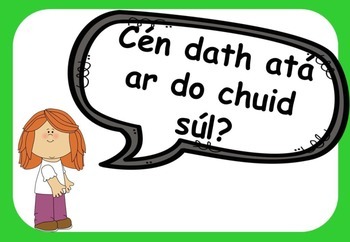
                                Gaeilge Rólimirt Poster & Worksheet Set Mé Féin (Irish Roleplay, Theme=Myself)

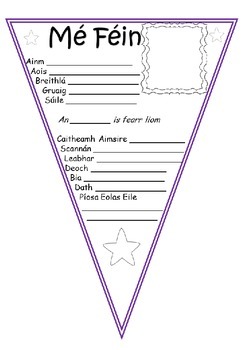
Mé Féin Bunting

This is a nice scríbhneoireacht activity to do in station teaching as it doesn't take too long and once the children know the language they should be able to do it almost independently. Again, I have differentiated versions available here. 

                                                    Bunting Mé Féin (Gaeilge)  Colour & Black/White

Draw the person/ éist, tarraing agus aimsigh an duine

This could be a nice éisteacht lesson. Read a description of a person to the children (cailín/buachaill, cén sort gruaig, dath na súile,  possibly include éadaí, and a badge with their age).
The children have to draw what they hear in the description and choose who they think it is in the classroom. Maybe it could also be a member of staff!

ICT Games/Cluichí Ríomhaire


These games are from one of the few Gaeilge sites that is very good and has some lovely interactive games. It has some differences in the words as it uses the Northern Irish dialect but is still a great resource to use.

Here are two games that link nicely to Mé Féin. Click on the images to be redirected to the website.


You could also download the Anseo Corp App onto the computers which has 6 games to revise the body parts. The clickable image will redirect you to where you can download it.


Bingo/Biongó

The children love Biongó. This is a set for the body parts (click on image to download resource). For the older children I make it more challenging by giving them two cards to mark. You can also make it more challenging for the child calling out the words by getting them to put it into a sentence e.g. Ghortaigh mé mo chos.
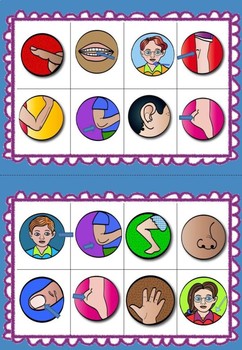
                                                   Biongó Na Baill Bheatha (Body Parts Bingo in Irish)